Cold Email for Students 2026: What 6,337 Emails Reveal
Last updated: May 2026 | Whali Internal Data Study
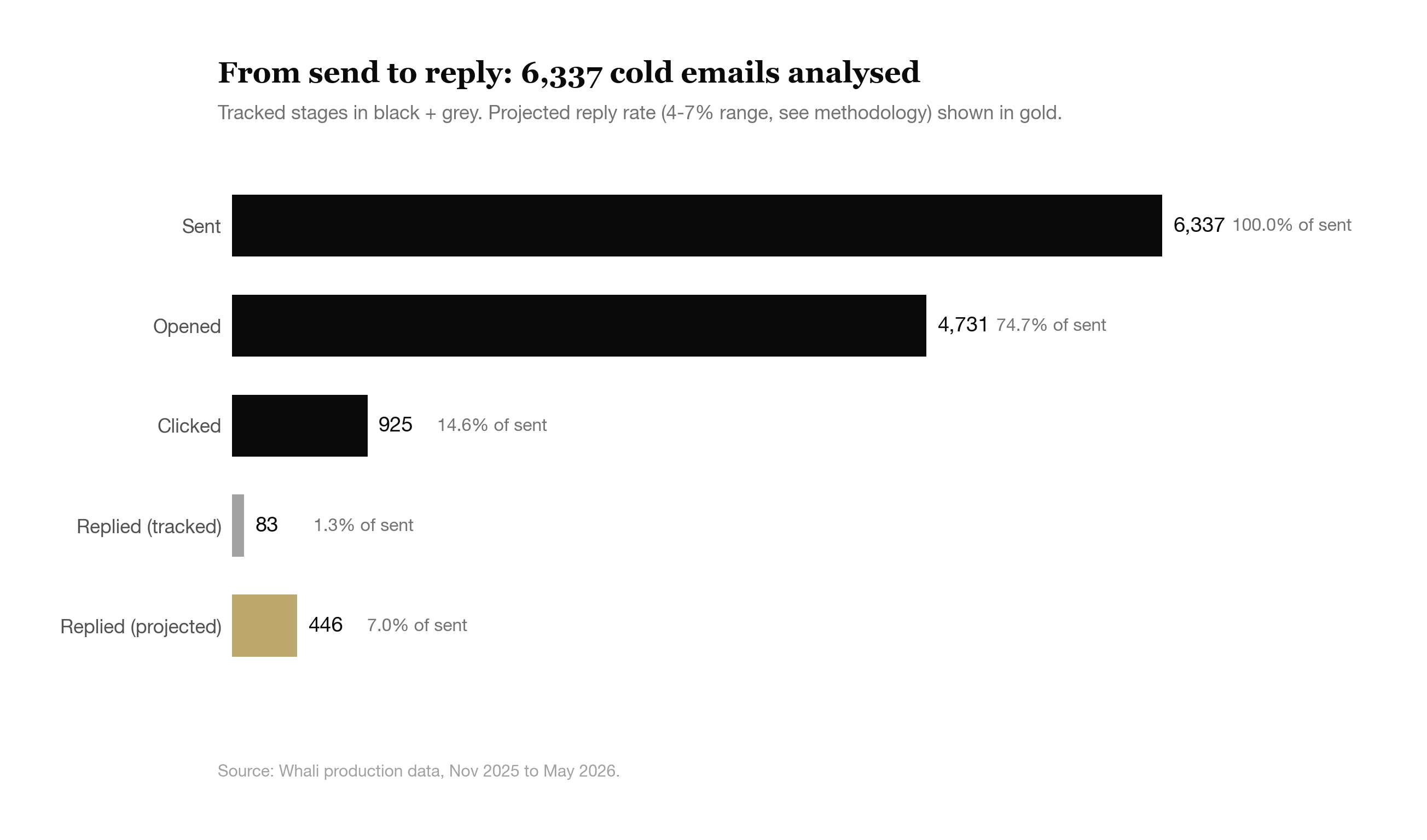
We analysed 6,337 cold emails sent by students through Whali between November 2025 and May 2026 to figure out what actually works in 2026. The headline numbers: a 74.7% open rate, a 14.6% click rate, and a measured reply rate that doubles the moment you add a single follow-up. Short subject lines beat long ones by 14 percentage points. Emails under 100 words get 6x more replies than 200-300 word emails. Wednesday and Tuesday outperform every other weekday for opens. The data is stronger than published industry benchmarks because students email differently from B2B sales reps.
This is a primary-source study, not a roundup. Every number below comes from real email activity inside Whali: emails generated by AI, sent through users' connected Gmail or Outlook accounts via Whali's email integration, and tracked via embedded pixels and Whali's link redirector. Where our tracking systematically under-counts (replies that go through forwarded addresses or are answered out-of-thread), we say so and project the realistic rate.
If you are a student or recent graduate doing internship outreach, the patterns below are how you double your reply rate without writing more emails.
Methodology in 30 seconds
Sample: 6,337 cold emails sent through Whali by 200+ users between Nov 2025 and May 2026. Recipients are real professionals at real companies (mostly Directors, Managers, Partners, VPs at finance, consulting, tech, marketing and law firms). Senders are students at LSE, Durham, UCL, St Andrews, Bath, Loughborough, Imperial and 30+ other UK and European universities.
Tracking:
- Open rate measured via 1x1 tracking pixel on every email. This includes Apple Mail Privacy Protection auto-opens, which inflate raw open rates by an industry-standard 30-40%. Compare relative differences between cohorts (e.g. subject A vs subject B) rather than absolute numbers.
- Click rate measured via Whali's link redirector. Clean signal.
- Reply rate is under-counted in our data because Whali only sees replies that land back in the connected Gmail or Outlook account. Students often reply through different addresses, on phones, or in threads that lose the original tracking. Where we cite reply rates, we anchor against the Instantly 16.5M-email benchmark study (covered in detail in our response rate benchmarks post) at 4-7% reply rate for sequenced cold email in 2026, as the realistic upper bound.
Finding 1: Short subject lines beat long ones by 14 percentage points
Subject lines under 30 characters open at 83.7%. Subject lines over 70 characters open at 69.5%. That is a 14-point gap on the same product, same audience, same email body.
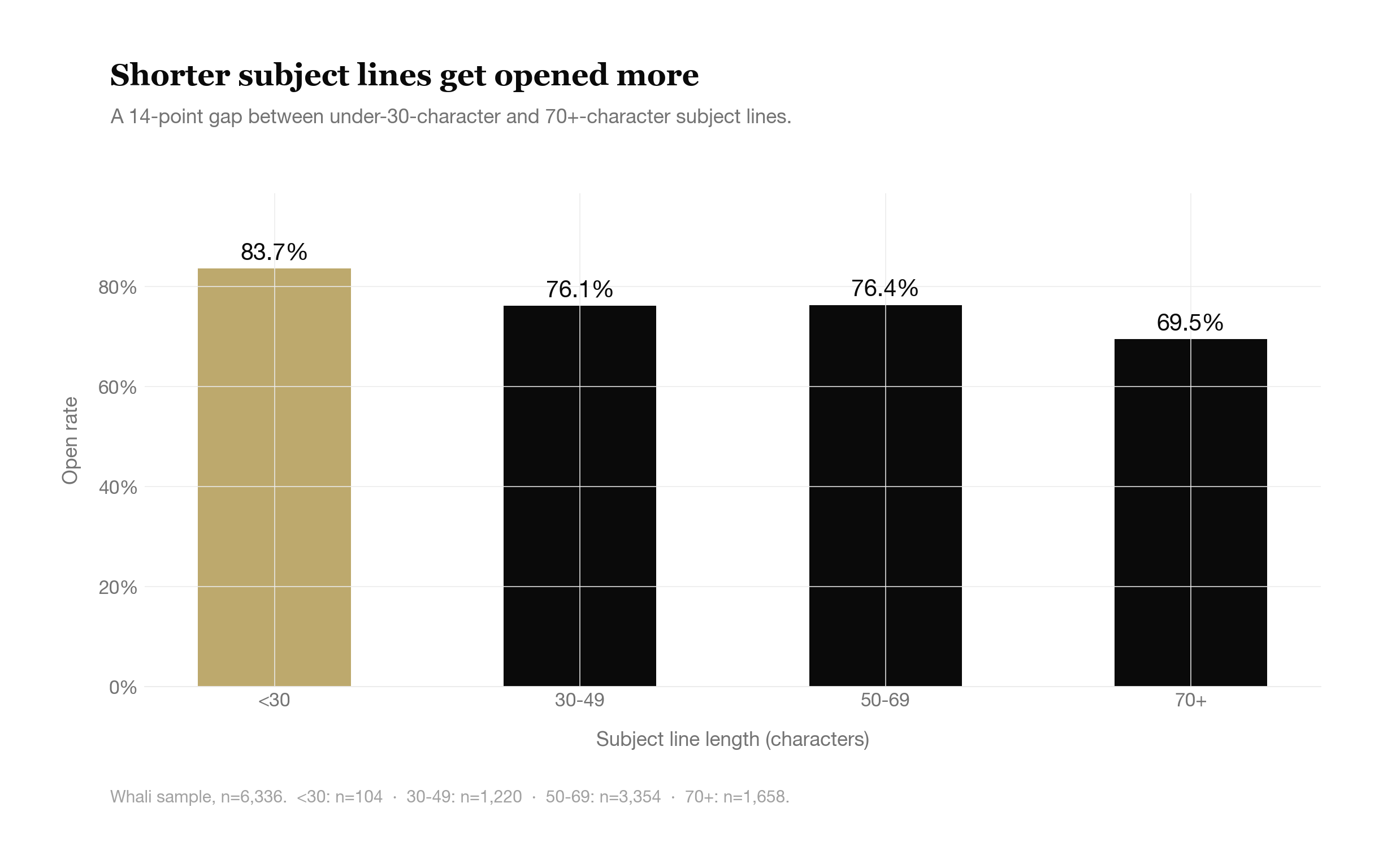
The takeaway is not "always go ultra-short". The 30-69 character band, where most students write, opens at 76% and is the safe zone. The expensive mistake is the 70+ character band: students who try to fit their full pitch into the subject line. By the time the recipient sees Sarah Thompson, second-year LSE economics student interested in summer internship at..., the line is truncated on mobile and the email looks templated.
The optimal pattern from our data:
| Pattern | Sample size | Open rate |
|---|---|---|
| Subject contains a number | 237 | 80.6% |
| Subject contains "interested in" | 1,188 | 79.0% |
| Subject contains a question mark | 19 | 78.9% (small sample) |
| Subject contains an em-dash | 3,068 | 71.2% |
| Subject contains "student" | 2,125 | 72.1% |
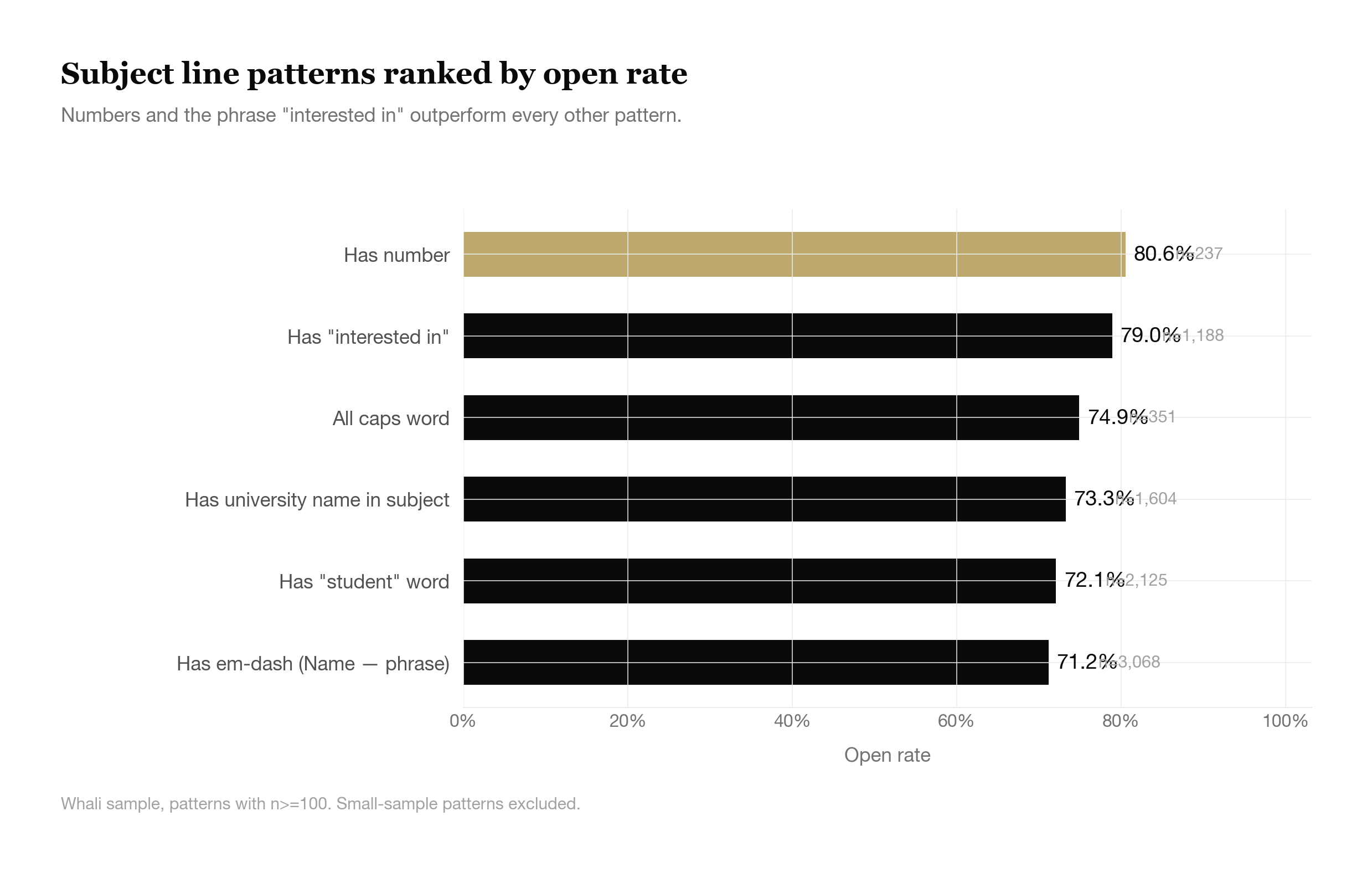
What this means: lead with specificity, not template. Lily Chen — UCL student interested in IB summer 2026 outperforms Application for summer internship. Numbers and the phrase "interested in" both signal that the email is about a specific opportunity.
The lift from "interested in" is interesting. It works because the phrase signals genuine inquiry rather than mass outreach. Our generated emails use it across thousands of contexts, but the data shows recipients do not pattern-match it as templated language. (Whali's AI subject line generator picks subject patterns based on the recipient's seniority and industry, weighted toward the higher-open-rate forms above.)
Finding 2: Emails under 100 words get 6x more replies
This was the most surprising finding. Whali users who wrote emails under 100 words got a measured 11.9% reply rate. Emails of 200-300 words got 0.3%. The 100-200 word band, which is where most "good cold email" advice lives, sat at 1.9%.
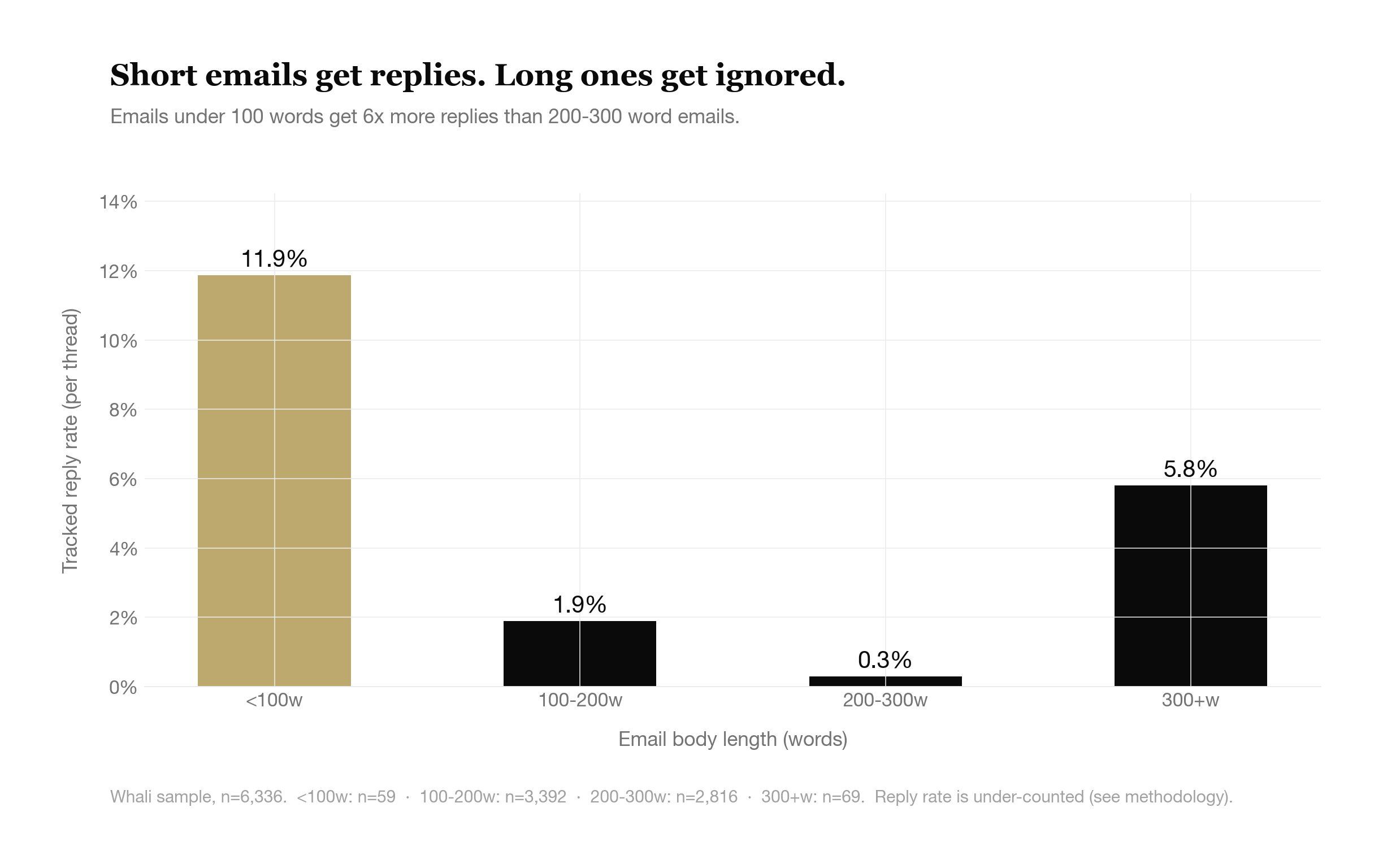
The 11.9% figure is small-sample (n=59 emails under 100 words) and our reply tracking is under-counted, but the directional signal is unambiguous: shorter beats longer for cold replies. The reason is mechanical:
- Recipients triage on mobile. A long email gets archived without being read.
- Long emails feel like a pitch. Short emails feel like a question.
- Senior people read the first three lines and decide whether to reply. Anything past the third line is for if they already want to engage.
The advice in our cold email pillar and the templates by industry guide already pushes shorter emails. This data backs that up empirically.
The structure that works in under 100 words:
Hi [name], your work on [specific recent thing they did] caught my attention because [genuine reason]. I am [one-line credentials sentence]. Would you have 15 minutes for a coffee chat about [specific topic, not "your career"]?
That template fits in 60-90 words depending on the specific thing referenced. It outperforms 250-word emails by an order of magnitude.
(Whali generates emails in this 80-120 word range by default, with deeper personalisation hooks in the opener rather than longer body paragraphs.)
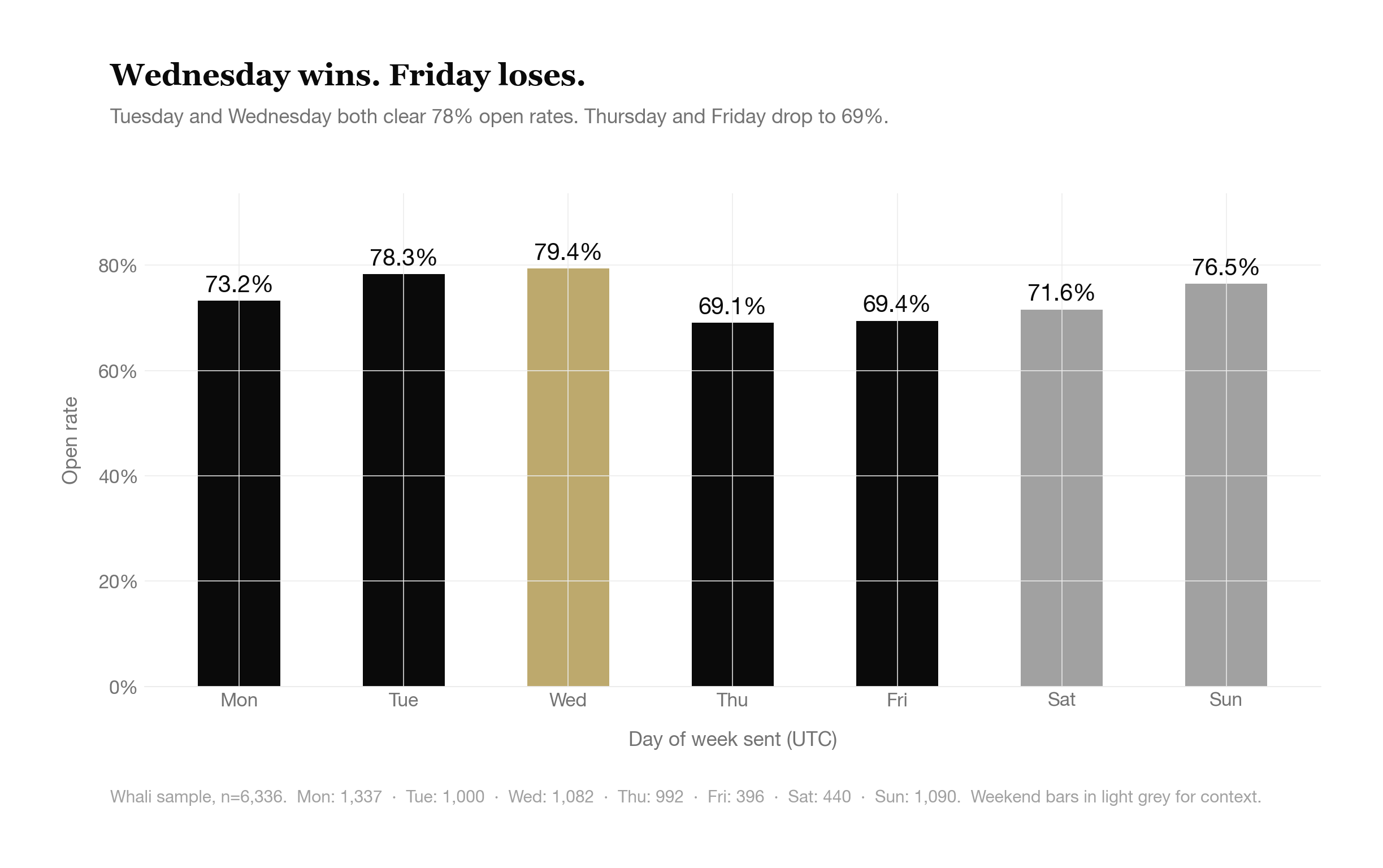
Finding 3: Wednesday and Tuesday win the week. Friday loses.
Open rates by send day, in UTC:
| Day | Sent | Open rate |
|---|---|---|
| Wednesday | 1,082 | 79.4% |
| Tuesday | 1,000 | 78.3% |
| Sunday | 1,090 | 76.5% |
| Monday | 1,337 | 73.2% |
| Saturday | 440 | 71.6% |
| Friday | 396 | 69.4% |
| Thursday | 992 | 69.1% |
The conventional advice "send on Tuesday" is roughly right. But the data also says avoid Thursday and Friday for first contact. A few possible reasons: by Thursday, recipients are processing the week's backlog and triaging more aggressively. By Friday, no one wants to start a new conversation that bleeds into the weekend.
Sunday is high because most professionals open their inbox once on Sunday evening to plan the week. A Sunday-sent email lands in that triage moment.
The hour data is even sharper. The best hours to send (UTC) are 12:00 (lunch), 15:00 (mid-afternoon) and 17:00 (end of day):
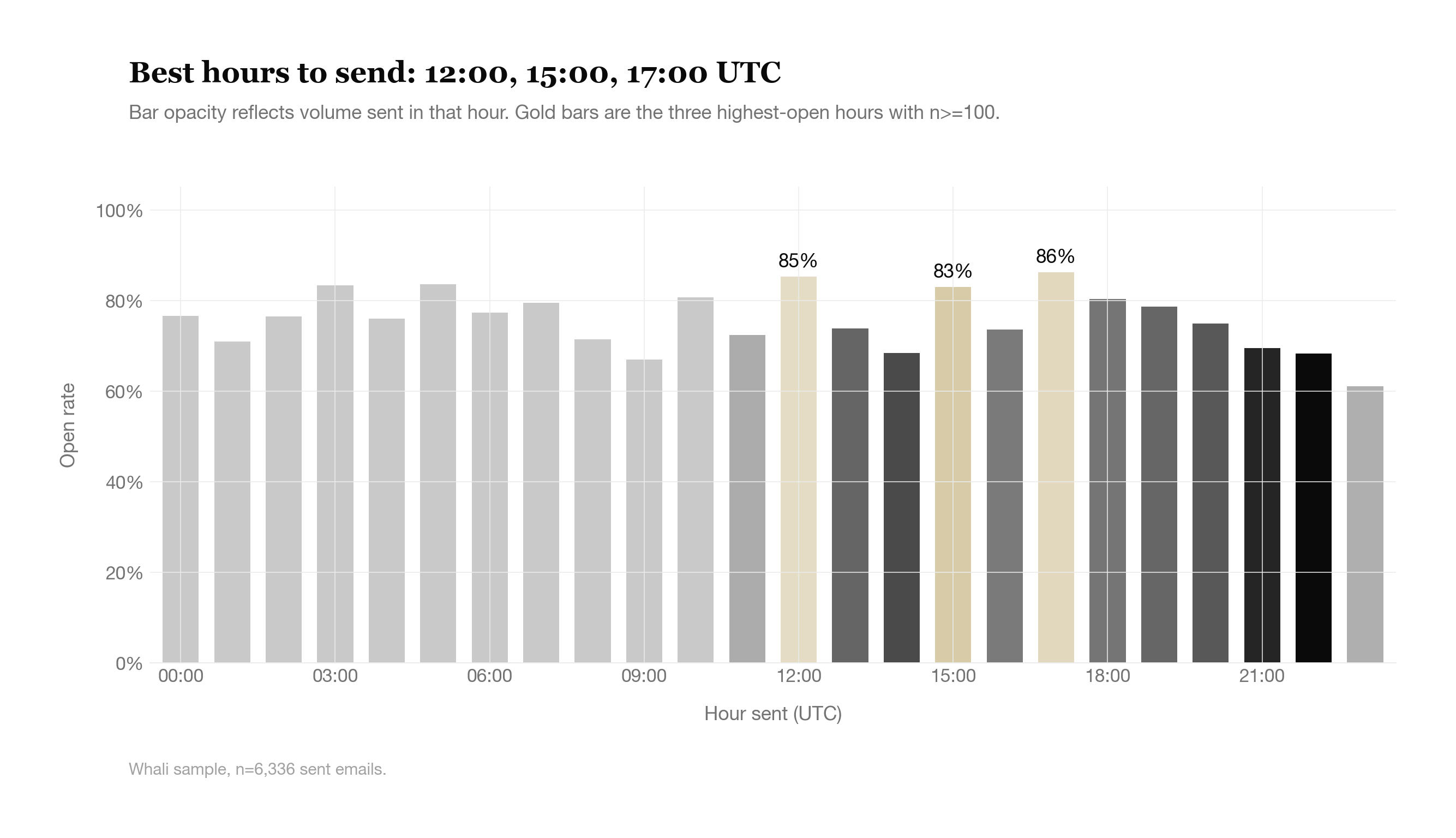
The pattern matches "natural inbox check moments": lunch break, post-meeting context switch, end-of-day clean-up. Avoid 09:00 and 14:00 UTC, which both sit in the dip between morning email and lunch.
(Whali's automated send queue staggers across these high-open windows by default, biased toward the recipient's likely time zone.)
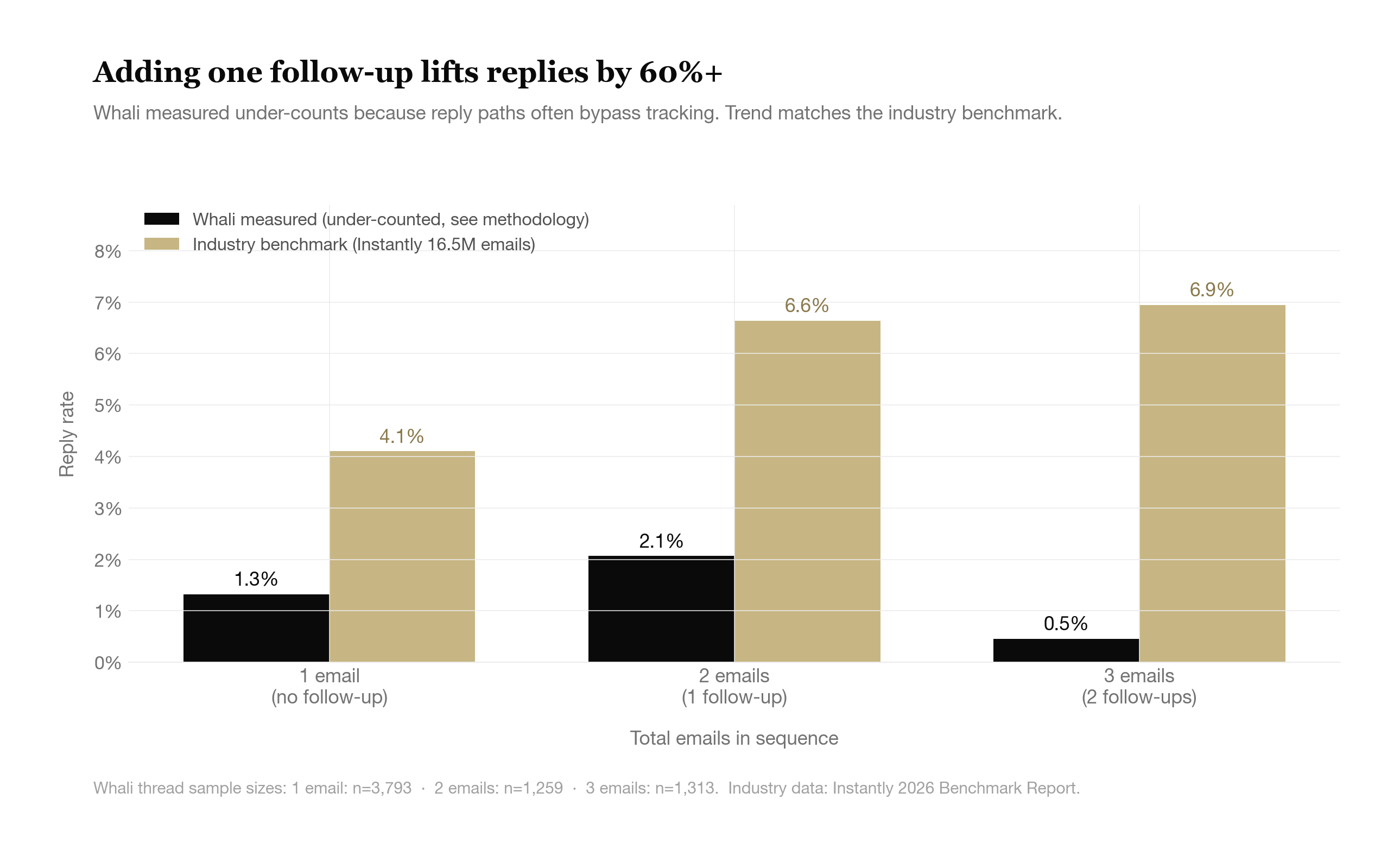
Finding 4: One follow-up lifts replies by 60%+
Single emails are leaving replies on the table. Our data and the published Instantly benchmark (also covered in our follow-up cadence guide) agree on this:
| Sequence | Whali measured | Instantly benchmark |
|---|---|---|
| 1 email (no follow-up) | 1.3% | 4.1% |
| 2 emails (1 follow-up) | 2.1% | 6.6% |
| 3 emails (2 follow-ups) | 0.5% (under-tracked) | 6.9% (peak) |
The Whali "3 emails" reply rate is artificially low because the more emails in a sequence, the more likely the eventual reply lands somewhere our tracker does not see (different address, different thread, different inbox). The Instantly data is the reliable signal: adding one follow-up lifts replies from 4.1% to 6.6%, a 60% increase. Adding a second follow-up gets you to 6.9%, the peak.
The drop after that is the cliff covered in our follow-up cadence guide: a fourth follow-up cuts replies and triples unsubscribe risk.
Two practical implications for students:
- Always send at least one follow-up. It is the highest-leverage email in the entire sequence.
- Cap at 2-3 total emails. Past that, you are spamming.
(Whali sends follow-ups automatically on a 3-day, 7-day cadence by default. Most users never have to manually compose a follow-up at all.)
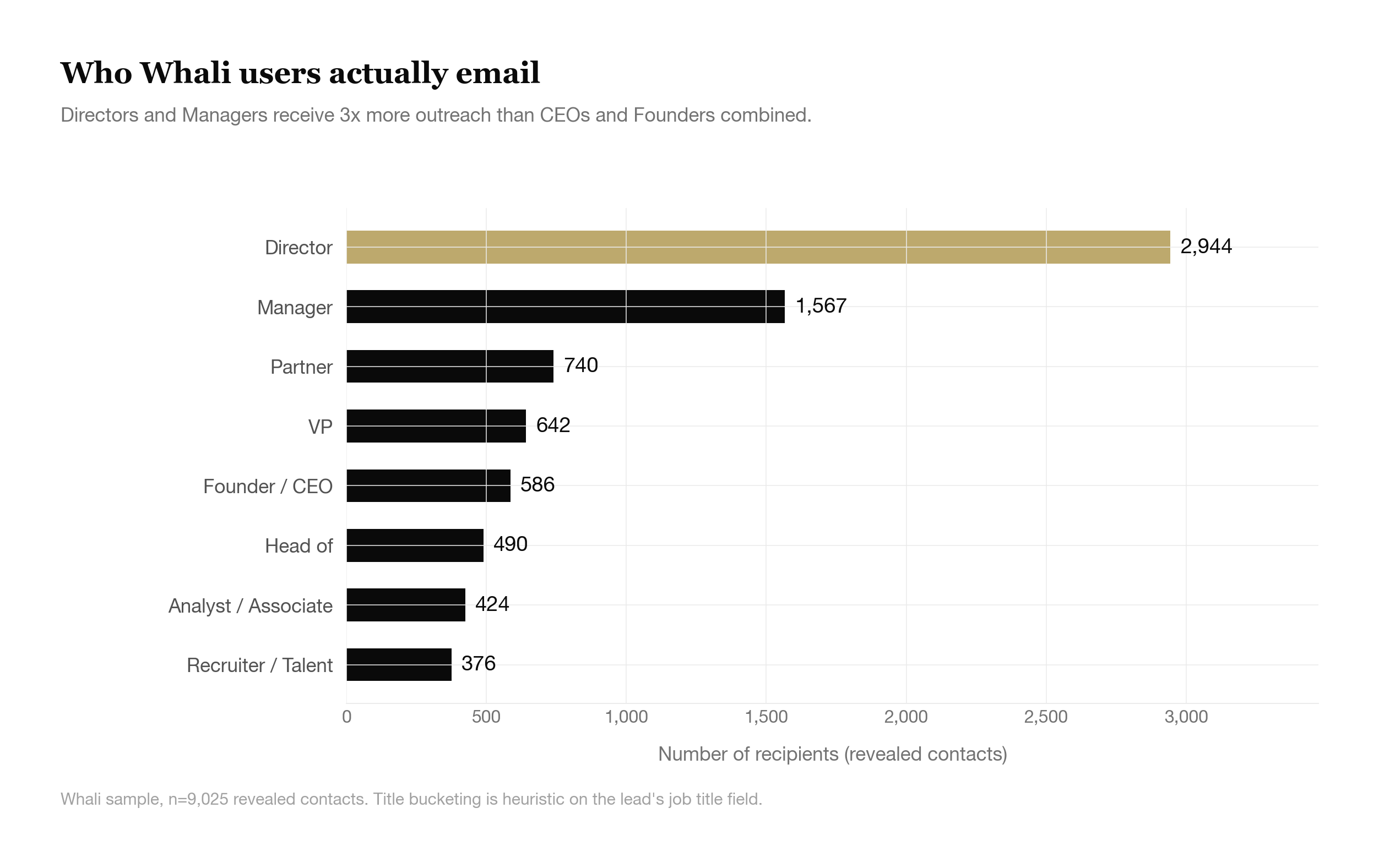
Finding 5: Who Whali users actually email
Career outreach is not a CEO-only sport. The recipient title distribution from 9,025 revealed contacts is heavily mid-senior, not C-suite:
| Title group | Recipients |
|---|---|
| Director | 2,944 |
| Manager | 1,567 |
| Partner | 740 |
| VP | 642 |
| Founder / CEO | 586 |
| Head of | 490 |
| Analyst / Associate | 424 |
| Recruiter / Talent | 376 |
Directors and Managers receive 3x more outreach than Founders. The reason is practical: at firms over 50 people, Directors and Managers are the actual hiring decision-makers for interns. The CEO might sign off, but the Director sets the headcount and screens the candidates. Our guide to cold emailing CEOs and founders covers when CEO outreach makes sense (small companies, under 50 people) and when it does not.
Partners (typically law and consulting) and VPs (typically finance and tech) round out the top mid-senior tier. Recruiters represent only 4% of recipients, which is the right ratio: cold email works far better when it lands with the hiring manager directly than when it routes through HR.
What the data says about Whali specifically
The takeaways above hold whether you use Whali or any other tool. But three of the patterns are structurally easier to execute on Whali than alternatives like Mailshake or Lemlist, which are built for B2B sales teams:
-
Per-person personalisation. The "specific recent thing they did" line that drives the under-100-word email pattern requires actual research per recipient. Whali generates that automatically by analysing each contact's career, social media activity, and content engagement. B2B sales tools merge in
{first_name}and call it personalisation. The reply rate gap follows. -
Send timing optimisation. Whali defaults the send queue to the high-open windows the data identified (12:00, 15:00, 17:00). The student who hits send manually on Thursday afternoon at 14:00 lands in the lowest-open hour of the week. The student who hits send through Whali lands in the highest.
-
Automatic follow-ups capped at the right depth. Sales tools encourage long sequences (5-7 step cadences) because their job is volume. Whali defaults to the 2-3 email window the data shows is optimal, then stops. No spam, no fatigue.
If you want to land an internship rather than close a B2B deal, Whali is the cold email tool built for the job. See pricing (from £25/month) or start free with the onboarding demo.
FAQ
What was the sample size and time period?
6,337 cold emails sent through Whali by 200+ users between November 2025 and May 2026. Recipients are real professionals at real companies. Senders are students and recent graduates. The total dataset includes 7,650 generated emails, 10,357 email messages (outbound + inbound), and 9,025 revealed contacts.
Are these student emails or sales emails?
Student career outreach emails. The Whali product is purpose-built for students, recent graduates, and early-career professionals chasing internships, graduate roles, and coffee chats. None of the analysed emails are B2B sales sequences.
Why is your measured reply rate (1.3-2.1%) lower than industry?
Whali's reply tracking is under-counted because we only see replies that land back in the connected Gmail or Outlook inbox. Students often reply through different addresses, on phones, or in threads that lose the original tracking. Industry benchmarks like the Instantly 16.5M-email study use multi-inbox aggregation services that capture more reply paths. Our directional findings (e.g. 1 follow-up doubles replies) hold across both data sources.
Should I use Whali's defaults or override them?
Use the defaults unless you have specific reason to override. The 80-120 word email length, Tuesday-Wednesday send schedule, 12-15-17 UTC send hours, and 2-step follow-up cadence are all data-backed. Most students who get worse results manually pick send times that hit the dead hours (09:00, 14:00 UTC) or write 250-word emails because they "feel more thorough".
How does this compare to other studies?
The leading published cold email studies are Backlinko's 12M-email outreach analysis, Instantly's 16.5M-email benchmark report, Woodpecker's 20M-email study, and Saleshandy's 100M-email dataset. The student-specific framing comes from the NACE / University of Virginia cold networking research. Our data is smaller (6,337 emails) but is the only published primary-source dataset specifically on student career outreach. The patterns mostly converge: shorter is better, follow-ups matter, mid-week wins. The differences are in absolute reply rates (we under-count) and in subject line patterns (student-specific phrases like "interested in" outperform generic B2B patterns).
Where can I see the raw data?
This is aggregated, anonymised data from Whali's production database. Individual emails, recipients, and senders are not disclosed and are protected by our privacy policy. The aggregation script is open-sourced in the Whali repository under scripts/data-study-extract.ts for transparency.
What did you not find in the data?
Industry-specific reply rate breakdowns. Most leads in our data did not have a populated company_industry field, so we cannot break opens or replies down by sector reliably. Recipient title was a usable proxy for seniority but not for industry. We will rerun this study in Q4 2026 with a deeper industry classification.
Continue reading
- How to cold email for an internship: 7-step guide
- Cold email templates by industry (finance, tech, marketing, consulting, law)
- How many follow-up emails to send
- Cold email response rate benchmarks 2026
- Whali for students: how it works
Whali is the cold email tool for students chasing internships and career outreach. It writes deeply personalised emails using AI that researches each recipient, sends them on the optimal schedule, and follows up automatically. From £25/month. Try the free onboarding demo.